
Memory as a Rewritten Record
The Book of MirrorsThis flow traces how the novel turns memory from an apparent record of experience into a changing account shaped by suggestion, emotion, and later discoveries.
increasing Bearing strength in each event
 decreasing
Bearing strength in each eventdecreasingThe First Memory

A Memory Put on Trial
Ordinary Detail
Richard Flynn recalls a childhood visit to Philadelphia: a balcony, a green cupboard, a wooden slat, and the smell of cooking. The recollection feels modest and concrete, precisely the sort of detail that seems to certify its authenticity. Joseph Wieder challenges that confidence by asking why this fragment survived when an event as momentous as the moon landing did not.
Memory Under Suggestion
Wieder’s questions turn the scene into a case study. He proposes that an apparently harmless recollection might conceal fear, pain, or danger, while the remembered version has been softened into something manageable. His argument does not prove that Flynn’s memory is false, but it unsettles the assumption that vividness guarantees accuracy.
The exchange introduces the novel’s central epistemic problem: recollection is not a neutral recording but a reconstruction made from surviving fragments. Once a memory is questioned, its gaps invite competing explanations, and the questioner may influence what the witness believes he has always known.
The Mall Experiment

Suggestion Creates a Past
A Manufactured Recollection
At dinner, Joseph Wieder describes an experiment in which students were hypnotically led to believe they had been lost in a shopping mall as children. Many later supplied vivid details: fear, helpful clerks, and announcements over the speakers. The stories felt like personal memories even though the event had never occurred.
The Witness as Collaborator
Wieder’s example makes memory appear collaborative rather than simply deceptive. A suggestion supplies a possible frame; cultural fears and scraps of genuine experience provide material; the subject’s mind then turns those materials into an emotionally persuasive scene. The resulting certainty can outlast the information that produced it.
The experiment foreshadows the danger facing everyone who recounts the murder. Interviewers, friends, investigators, and storytellers do not merely collect memories: their questions can alter them. The novel therefore treats confidence as a psychological fact, not as proof that an account corresponds to the past.
The Returning Past
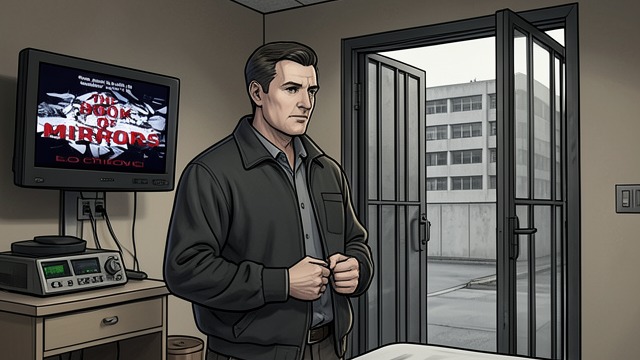
A Past Returning Without Warning
Identity Without Recollection
After the attack at Trenton Psychiatric Hospital, Derek Simmons can form new memories but cannot retrieve his earlier life. He relearns practical skills and facts about himself as though studying another person’s biography. His name and outward continuity survive, yet the experiences that would make those facts feel like his own remain inaccessible.
The Sudden Release
Years later, a television report about a former colleague triggers a cascade of memories. Derek recognizes a man and realizes that the knowledge has not come from anyone’s explanation. The returning recollections disclose his unhappy marriage and his connection to Joseph Wieder, but they also restore rage and suspicion that his post-amnesia life had kept at a distance.
Derek’s story makes identity dependent on more than a stable body or a continuous name. Memory can disappear, return, and reorganize the self, while the person who remembers may have to judge whether the recovered story is genuine, distorted, or emotionally unbearable.
A Life Remembered Through Illness

The Threat of Forgetting
A Detective’s Fading Certainty
Roy Freeman reopens the case while facing an Alzheimer’s diagnosis. He knows that names, streets, and episodes may soon become inaccessible, and he turns the investigation into a deliberate exercise in keeping his mind active. The case is both a search for what happened and an attempt to preserve his own capacity to think.
Choosing What Remains
After confronting Derek Simmons and arranging his arrest, Freeman imagines which memory he would most want to keep. He chooses not the solved crime but the calm ride toward the airport and the hope of seeing Diana again. The choice gives personal attachment greater value than professional achievement or the satisfaction of closing a case.
Freeman’s ending echoes the novel’s other damaged recollections: remembering is vulnerable, but so is deciding what deserves to be remembered. As the case recedes from his mind, the emotional meaning of the present moment becomes his chosen defense against erasure.
The Reader’s Revised Memory
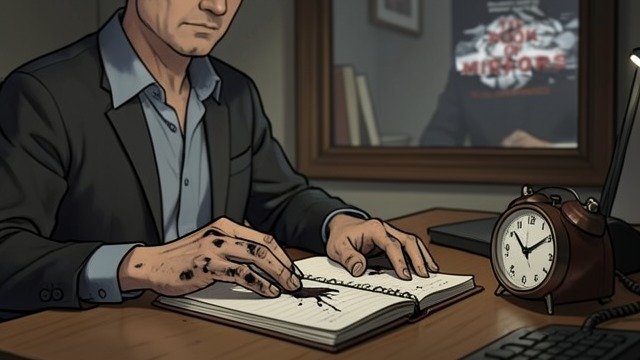
Reading the Past Again
Competing Versions
Peter Katz receives the complete manuscript after the investigation has already transformed the apparent story. Richard Flynn’s account, Derek Simmons’s testimony, Laura Westlake’s explanations, and Roy Freeman’s reconstruction do not settle into a single transparent record. Each offers a pattern that seems persuasive until another detail makes that pattern unstable.
The Mirror Effect
The final reflections identify the characters’ recurring error: they see their own fears and desires in other people, then mistake that image for knowledge. Flynn reads betrayal into Laura’s actions; Simmons interprets care through the grievance of his former life; others make the available facts fit their preferred account. The reader has been drawn into the same interpretive process.
The novel’s ending does not simply disclose an answer. It asks the reader to look back at earlier certainty and recognize how easily narrative arrangement turns partial information into an apparent truth. Recollection is always also interpretation, and a new account can change the meaning of what seemed settled.
1987, during Richard Flynn’s first dinner with Joseph Wieder
1987, during the snowy dinner at Joseph Wieder’s residence
1987, as Derek Simmons describes his life after the hospital attack
Near the ending, after Roy Freeman’s diagnosis and final interview with Derek Simmons
At the epilogue, after Danna Olsen sends Peter Katz the complete manuscript
